A beverage-quality intelligence platform Khula has specified end to end — sensory evidence and deterministic statistics behind every human release call.
Evidence before action — quality decisions you can audit.
Halocline runs blind sensory panels and a deterministic statistics engine behind every Release, Hold or Reject. The maths reports confidence and control limits; a qualified human, not a model, makes the call — and the whole trail is reproducible.
The demo shows the designed application flow and UI/UX with sample data — a working prototype, not a live deployment.
Quality risk is invisible until it crosses a line.
A halocline is the sharp layer in water where salinity and density change — unseen from the surface, but real. Beverage quality behaves the same way: a batch reads fine until a panel mean drifts past a governed threshold. Halocline exists to make that boundary visible before a release, not after a recall.
Most beverage QA still lives in spreadsheets and tasting-room memory. A number gets written down; the uncertainty around it does not. Nobody can later reconstruct which assessors sat, what the confidence interval was, or why a batch shipped.
Halocline treats every quality reading as evidence with a boundary attached — a panel mean, a confidence band, control limits, a governed threshold, and the decision line where a human takes over.
Four stages, one direction: batch to decision.
Every batch travels the same path. Statistics sit at the centre — they quantify the evidence, then hand off to a person.
Batch
Blind sampling and offline tablet ballots from the plant floor.
Panel
Qualified assessors run governed sensory methods under protocol.
Statistics
Deterministic engine: means, CIs, control limits, sufficiency.
Decision
A human QA disposition: Release, Hold, Reject and beyond.
It starts blind, on the floor, offline.
A batch is sampled into blind, coded aliquots so no assessor can see which product or line they are scoring. Eligibility is checked against the protocol before a session opens.
Ballots are captured on tablets that work in an encrypted offline queue — cellar floors and bottling halls rarely have reliable signal. Responses sync when the device reconnects, and nothing is scored until the panel is complete and valid.
The result is a clean, tamper-evident starting point: known samples, known assessors, known protocol — before a single number is calculated.
The panel is only as good as its methods and its people.
Halocline ships a method pack for the questions QA actually asks — and a Training Academy that keeps the assessors behind them qualified.
Quantitative Descriptive
How intense is each attribute? Builds a scored sensory profile against the product spec.
Triangle test
Is there any perceptible difference between two samples? One of three differs — find it.
Paired comparison
Which of two samples has more of a named attribute? A directed, two-sample call.
Duo-trio test
Which sample matches the reference? Difference testing anchored to a known control.
Ranking
Order several samples by an attribute — sweetness, bitterness, off-note intensity.
Hedonic scale
How much is it liked? Consumer-style acceptance, kept separate from the technical panel.
Open identification
Name the character or defect freely — captures faults a fixed ballot would miss.
Protocol-locked
Each method runs under a versioned protocol, so a result can be reproduced exactly.
The Training Academy
Assessors are not born calibrated. The Academy qualifies people across four tracks, holds them to a knowledge threshold, and expires the credential so calibration never drifts unchecked.
Deterministic by design. Auditable by default.
The statistics engine is an isolated Python service with one job: turn valid panel data into quantified evidence — the same inputs always producing the same outputs.
Every calculation runs against an immutable manifest: profile scoring, ANOVA, ICC for panel agreement, EWMA and T²/Q control limits, guarded PCA, 95% confidence intervals, and an evidence-sufficiency check. Each run writes a deterministic digest, so a result can be re-derived and verified months later.
The engine reports what the evidence says — conforming, review, or nonconforming against the governed threshold — and where it is uncertain. It never releases a batch. That line is deliberate, and it is drawn in the data model, not just in policy.
Guarded PCA is guarded for a reason: dimensionality reduction that could hide a real signal is constrained, so the maths never quietly overrules a panel.
The AI guardrail
AI is optional and off by default. When switched on, it only drafts narrative around numbers the deterministic engine already produced — capped at ≤ 33% of report depth, always labelled, and always grounded in the underlying evidence. It never scores a batch and never makes a release decision. The statistics stay deterministic; the human stays accountable.
Six ways a human can dispose of a batch.
Evidence narrows the choice; it does not make it. A qualified reviewer records one of six dispositions, with a reason, into an immutable audit trail.
Evidence ≠ disposition.
The statistics tell you how confident you can be. What you do about it stays a human, accountable choice — recorded, reasoned, and reproducible.
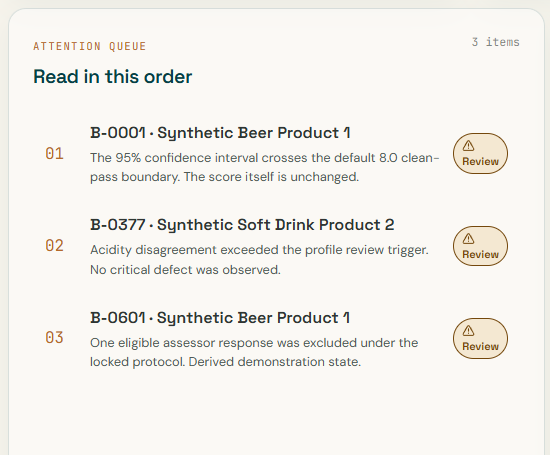
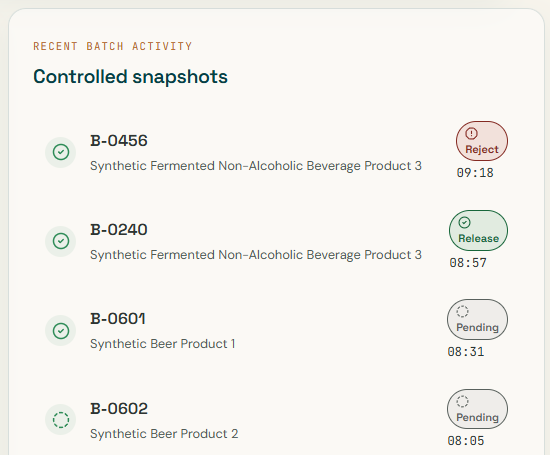
Two pieces of the same workspace.
Cropped straight from the pilot interface — built against synthetic data, not live customer batches.
Isolation from the first row of data.
Multi-tenant means one plant can never see another’s evidence. Isolation runs through database rows, API capabilities, storage paths, jobs, exports and audit — and the statistics service is deliberately kept at arm’s length from release.
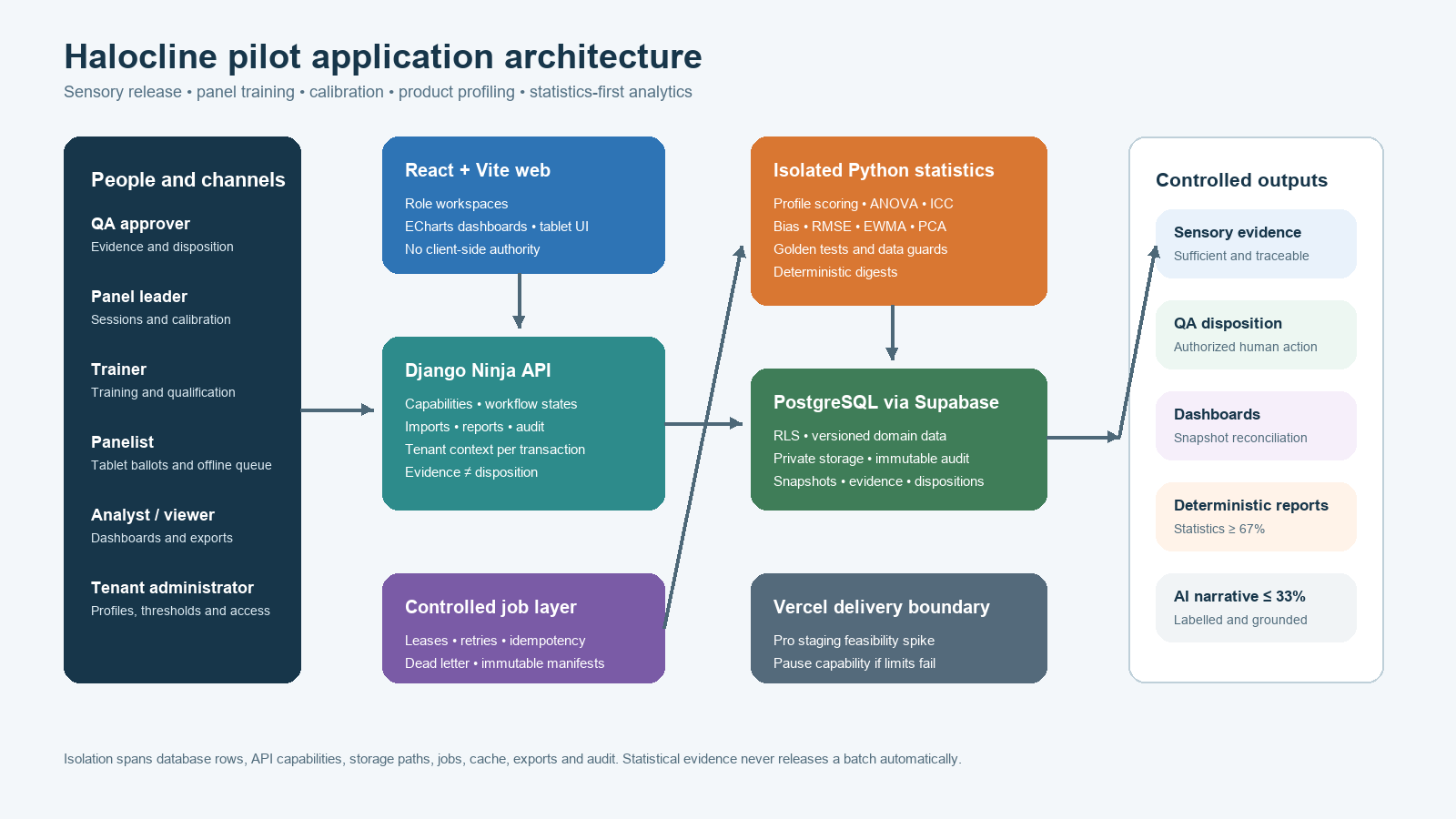
Planned architecture. Statistical evidence never releases a batch automatically — it flows to a human, and the disposition is recorded separately.
Planned stack, front to back
The same spec. A very different delivery clock.
The Halocline specification is complete and the plan is approved. What follows is a projection of how long the build takes — the conventional route versus Khula’s AI-assisted one.
Forward-looking estimate. Figures are a projection from the approved plan, not a delivered result.
Priced for a small plant or a global manufacturer.
Three tiers scale from a single site to multi-site enterprise QA. Indicative ranges from the plan.
For small plants running a single site — core batch tracking, panels and the deterministic evidence engine.
For mid-market beverage groups — multiple sites and SKUs, the full Training Academy, and controlled reporting.
For large manufacturers — site-scaled deployment, deeper governance, isolation and integration commitments.
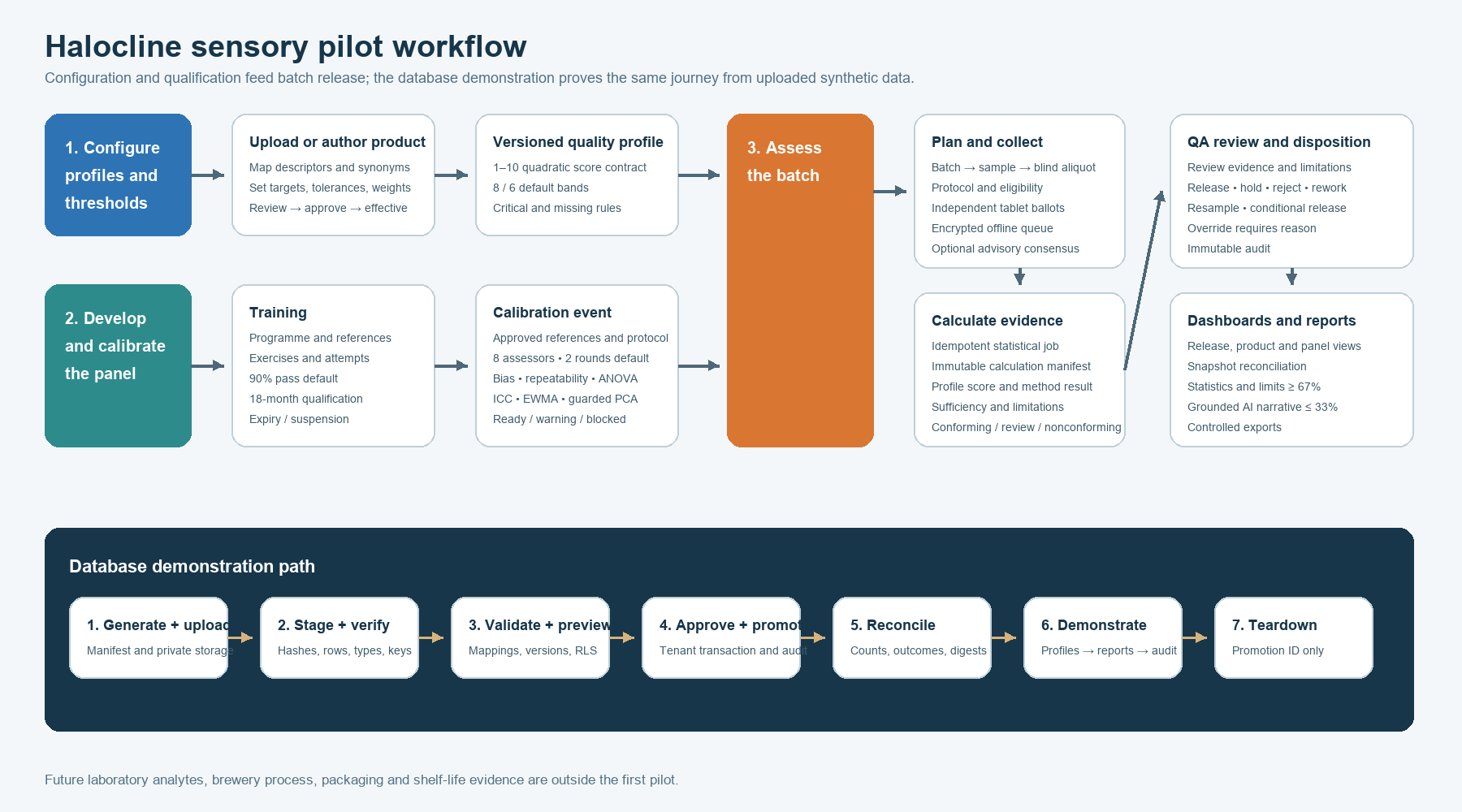
Spec first. Then build fast.
Halocline exists as a complete specification before a line of production code — every workflow state, method, threshold and audit rule written down and agreed. That discipline is what makes an AI-assisted build safe to run quickly: the plan is the contract, and Khula executes against it rather than improvising. It is the same method Khula brings to every engagement — understand the domain deeply, specify it precisely, then compress delivery.