Applied AI, examined honestly.
Hard problems explored end to end — from research and data modelling to working software or a clearly labelled planned concept. Each case shows technical depth carried into a different domain: quality science, consumer product, compliance, biotech and operations.
Applied AI & software builds
From real business problems to working software, end to end — for teams a generic tool can’t serve.
Your admin, handled by AI
The repetitive parts of your week, automated where appropriate. Results are measured against each client's real baseline.
One builder, the full arc — research to working software.
Every case on this page was developed by Mangethe Zwane, who spent fifteen years in analytical chemistry, sensory science and data analytics for the global brewing industry before applying that rigour to software. The method is consistent — start from the real business problem, model the data honestly, then build only what the evidence supports. Each case is labelled as shipped, prototype, or planned. Research → data model → working system, with no hand-off gap where the domain understanding leaks out.
The builds run on a deliberately boring, proven stack — Next.js and React on the front end, Supabase Postgres with row-level security underneath, TypeScript throughout — chosen so that multi-tenant isolation, an immutable audit trail, and 80%+ test coverage are the default rather than an afterthought. AI is used as the primary build assistant to compress the writing of that code, under human review, not bolted into the product: several systems ship with AI optional and off by default.
Where the problem is genuinely hard — turning raw mass-spectrometry data into a scored, cited compound workbook, or standing deterministic statistical evidence behind a beverage Release / Hold / Reject decision — the work goes deeper than wiring an API to a chatbot. It is data engineering and applied AI at R&D depth: cleaning, scoring, ranking, provenance and reproducibility, built to be evaluated by a scientist rather than trusted blindly.
The through-line is range with depth. The same person can architect a compliance SaaS in four days, ship an offline-first consumer PWA within free-tier limits, and coach a plant floor through SDCA/PDCA cadence — because the technical authority and the domain authority are the same authority. That is what this portfolio is built to prove.
Mangethe Zwane · Founder & principal engineer, Khula Platform
Tally — grocery planning & spend intelligence
A mobile-first PWA for South African households — plan, scan in-store, and see planned vs actual spend. Next.js 16, Supabase with row-level security, offline-first, tested and CI-delivered.
Proves: end-to-end delivery — ships real, production-grade software.
View case study →
Sawubona Mycelium — AI metabolite biomining
A bespoke AI workflow that turns raw mass-spectrometry data into a cleaned, scored, fully cited compound workbook — compressing weeks of lab research into hours.
Proves: R&D-grade technical comprehension + data/cheminformatics workflow design.
View case study →
SMP Operational Excellence — iterative SDCA + PDCA tools for productivity
A unified consultancy combining analytical science (ESR, GC, HPLC), operational diagnostics, quality management, and data-driven SDCA/PDCA cadence coaching for FMCG and brewing businesses across South Africa.
Proves: management-consulting rigour rooted in real technical authority.
View consultant profile →
Rootline — SLP compliance, plan to proof
A multi-tenant platform for South African mining operations to author, track, and prove their Social & Labour Plans — eight modules, built by Khula Platform in four days on Next.js and Supabase.
Proves: turning dense regulation into working, multi-tenant software — fast.
View case study →
Halocline — quality intelligence platform
A multi-tenant sensory-quality platform for breweries and beverage makers — deterministic statistical evidence behind every Release, Hold or Reject. Projected build: 6–10 days.
Proves: deep domain knowledge + data modelling + platform architecture.
View case study →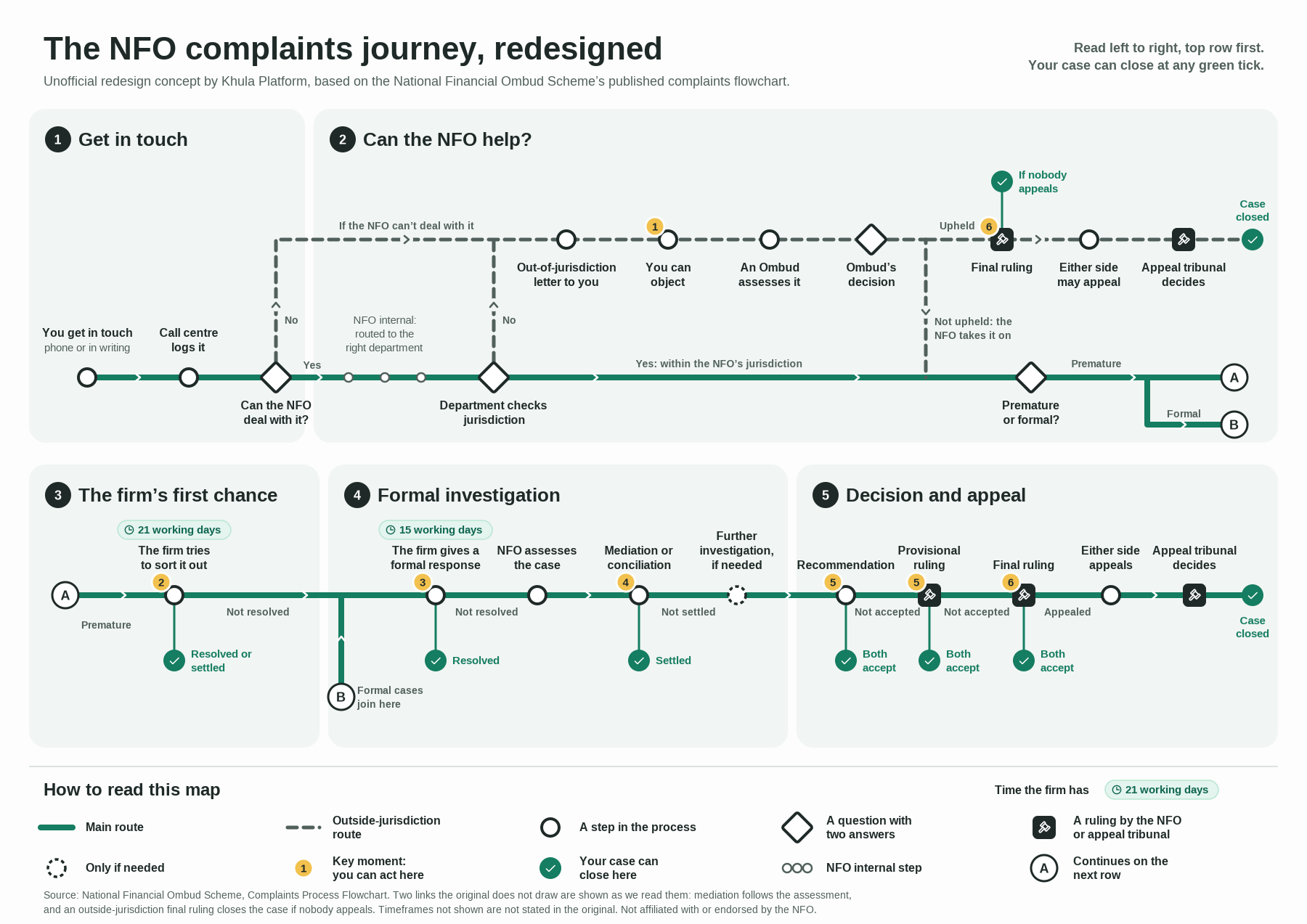
Ombud complaints journey — a clearer path from complaint to outcome
A concept redesign of a financial ombud’s complaints process: one map, five stages, plain-language steps and stated timeframes. Not affiliated with or endorsed by the NFO.
Proves: turning a dense regulatory process into a journey people can follow.
View concept →More case studies and consulting profiles are on the way — Khula Platform keeps proving its range across new industries.