Unofficial redesign concept. Not affiliated with or endorsed by the National Financial Ombud Scheme.
A complaints process people can actually follow
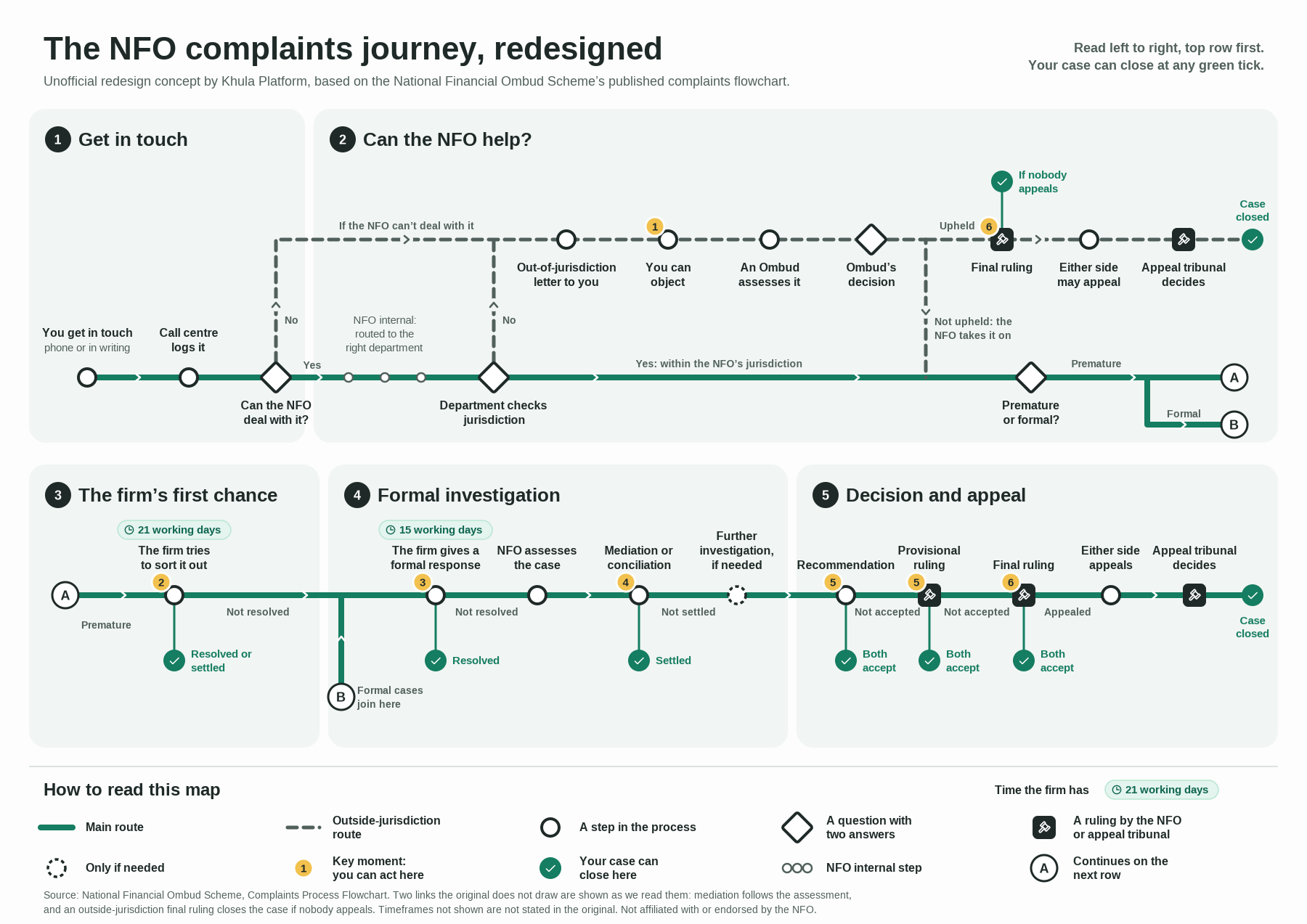
We redesigned the National Financial Ombud Scheme’s complaints flowchart so anyone can see where they stand at a glance.
Before and after
The published chart puts more than forty labelled boxes on one canvas. The redesign keeps every step and both stated timeframes, and fixes five problems. The numbered markers point to the same five places in each version.
Before

After
| Marker | Before: the original | After: the redesign |
|---|---|---|
| 1 | Two YES boxes for two different checks The call centre and the department both check jurisdiction, but the chart labels both answers just YES. |
Each check is named for who makes it, and both “no” answers lead to one side route. |
| 2 | Eight routes into two CLOSED circles Lines run from all over the chart into two separate CLOSED circles, crossing other routes on the way. |
A green tick sits on every step where a case can end. No long lines to trace. |
| 3 | A bottom row that reads right to left The climb from recommendation to appeal runs backwards across the page. |
Everything reads left to right, top row first, like a page of text. |
| 4 | Deadlines in small print The 21 and 15 working days the firm gets are buried inside step labels. |
Waiting windows are clock badges, and the six moments that need you are numbered. |
| 5 | Seven gavels and no legend One gavel icon marks seven different steps, from the first jurisdiction question to an appeal decision. |
One legend, and each symbol means one thing, shown with shape, colour and words. |
The whole journey in five stages
Pick the stage you’re in. Each one says what happens, who acts, how long it takes and what you can do.
- Key moment: you can act
- Working days the firm has
- Your case can close here
Get in touch
You’re here if you have a complaint about a financial firm and want the NFO’s help.
- What happens
- You contact the NFO. The call centre logs your complaint and makes a first check: can the NFO deal with it?
- Who’s involved
- You and the NFO call centre.
- How long
- Not stated in the original.
- What you can do
- Get in touch by phone or in writing.
You get in touch by phone or in writing.
The call centre logs your complaint.
Question: Can the NFO deal with it?
The NFO calls this jurisdiction.
- Yes: your complaint goes to the right department.
- No: you get an out-of-jurisdiction letter, and can object. See the side route
Can the NFO help?
You’re here if you’re waiting to hear whether the NFO can take your complaint, or you’ve been told it can’t.
- What happens
- The right department checks again whether your complaint falls within the NFO’s jurisdiction. If it does, the case is opened as premature or formal. If not, you get a letter explaining why.
- Who’s involved
- An NFO department, you, and an Ombud if you object.
- How long
- Not stated in the original.
- What you can do
- Key moment 1Object if you’re told the NFO can’t deal with your complaint.
NFO internalThe NFO decides which department should handle it.
NFO internalYour complaint is sent to that department.
NFO internalThe department receives it.
Question: Does the department agree the NFO can deal with it?
- Yes: the case is opened.
- No: the complaint goes to the side route below.
Question: Premature or formal?
- Premature: the firm hasn’t had its chance to fix things yet. Go to stage 3
- Formal: the NFO opens a formal case. Go to stage 4
If the NFO can’t deal with it
The NFO sends you an out-of-jurisdiction letter.
The original calls this an O/J letter.
Key moment 1You can object.
An Ombud assesses your objection.
Question: What does the Ombud decide?
- Not upheld: the NFO can deal with it after all. A division opens your case as premature or formal.
- Upheld: the complaint stays outside the NFO’s jurisdiction. A final ruling follows.
Key moment 6Final ruling Ruling
If nobody appeals, your case closes here.
Either side may appeal.
The appeal tribunal decides. Ruling
Your case closes here.
The firm’s first chance
You’re here if the NFO has sent your complaint to the firm to resolve first.
- What happens
- Your complaint is premature: the firm hasn’t yet had a proper chance to resolve it. The NFO sends it to the firm first.
- Who’s involved
- The financial firm (the NFO calls it the participant) and you.
- How long
- 21 working days for the firm to sort it out.
- What you can do
- Key moment 2Watch for the firm’s answer. If it doesn’t resolve things, your complaint moves on to a formal investigation.
Key moment 2The NFO sends your complaint to the firm.
Resolved or settled: your case closes here.
Question: Not resolved?
- The complaint becomes formal. Go to stage 4
Formal investigation
You’re here if your complaint is now a formal case.
- What happens
- The NFO sends the formal complaint to the firm. If that doesn’t resolve it, the NFO assesses the case and tries mediation or conciliation.
- Who’s involved
- The NFO, the firm and you.
- How long
- 15 working days for the firm’s response. Later steps: not stated.
- What you can do
- Key moment 4Take part in mediation or conciliation. Settling there closes the case without a ruling.
Key moment 3The NFO sends the formal complaint to the firm.
Resolved: your case closes here.
Not resolved: the NFO assesses and evaluates the case.
Key moment 4Mediation or conciliation.
Settled: your case closes here.
Not settled: the NFO investigates further, if needed. If needed
Decision and appeal
You’re here if you’ve received a recommendation or a ruling.
- What happens
- The NFO makes a recommendation. If either side is unsatisfied, a provisional ruling follows, then a final ruling. A final ruling can be appealed to the appeal tribunal.
- Who’s involved
- The NFO, you, the firm and, on appeal, the appeal tribunal.
- How long
- Not stated in the original.
- What you can do
- Key moment 5Accept, or say you’re unsatisfied. Key moment 6Appeal a final ruling.
Key moment 5Recommendation.
Both sides accept: your case closes here.
Key moment 5Either side unsatisfied: provisional ruling. Ruling
Both sides accept: your case closes here.
Key moment 6Either side unsatisfied: final ruling. Ruling
Both sides accept: your case closes here.
Either side appeals.
The appeal tribunal decides. Ruling
Your case closes here.
Six moments where you can act
Most of the process happens without you. These are the points where your answer, or the firm’s, decides what happens next.
- Key moment 1
Told the NFO can’t help? You can object.
An out-of-jurisdiction letter isn’t the end. Object, and an Ombud reviews the decision.
Stage 2: Can the NFO help? - Key moment 2
21 working days: the firm’s first chance.
If the firm hasn’t had a chance to fix things, the NFO sends it your complaint first.
Stage 3: The firm’s first chance - Key moment 3
15 working days: the firm’s formal response.
Once your case is formal, the firm has 15 working days to respond.
Stage 4: Formal investigation - Key moment 4
Mediation: settle by agreement.
A settlement here closes the case without a ruling.
Stage 4: Formal investigation - Key moment 5
Not happy with a recommendation or provisional ruling? Say so.
Either side can say it’s unsatisfied, and the case moves up to the next decision.
Stage 5: Decision and appeal - Key moment 6
Final ruling: either side can appeal.
The appeal goes to the appeal tribunal, and its decision closes the case.
Stage 5: Decision and appeal
Everything on one sheet
The full process on a single A3 page, for printing or sharing. The five stages above say the same in more detail.
How this redesign was made
It started as a one-paragraph brief. The brief was diagnosed first and turned into a full build specification, then built and checked with a fixed set of design and quality tools.
The brief, summarised
Redesign this process with a clear legend and clear signposts for its key areas. Today it is clunky and unreadable. The key areas need clear explanation, and the experience should be easy, not overwhelming, at the start.
What the brief got right
- It named the real problems: clunky, no legend, key moments buried, overwhelming at the start.
- It attached the source and set the right goal: a simple first view, with detail on demand.
Prompt diagnosis
| Gap in the brief | Risk | How the build closed it |
|---|---|---|
| The process existed only as an image | A misread arrow could invent or drop a step. | Every arrow traced, the process written out step by step, and the two unclear links confirmed with the owner before design began. |
| No audience, format or branding | The result could have been anything. | Agreed up front: public first with staff detail on demand, an interactive page plus an A3 PDF, Khula Platform branding. |
| “Key areas” not named | Callouts would have been guesswork. | Six named key moments, numbered the same way on the stepper, the stages and the map. |
| No rule on accuracy | A redesign could quietly change a legal process. | No invented steps, timeframes or statistics, and every assumption listed on the page. |
| No acceptance criteria | No way to know when it was done. | The repository’s design gates: zero linter findings, checks from 320 to 1920 px, a design review of at least 4.0, the policy check. |
| Branding risk | It reworks a real organisation’s material. | No NFO logo or brand colours, an unofficial-concept label, the source credited, and the page kept out of search. |
| A font conflict nobody mentioned | The brand display face fails the design linter. | Newsreader with Manrope, sizes set on fixed steps. |
Design components used
| Type | Component | What it did here |
|---|---|---|
| Skill | prompt-optimizer | Diagnosed the brief and wrote the build specification. |
| Skill | design-taste-frontend | Set the direction, trust-first wayfinding with an editorial voice, and its anti-template rules. |
| Skill | ui-ux-pro-max | Accessibility-first style guidance and process-map conventions: a thick main route, thinner side routes, a text summary. |
| Gate | impeccable detect | Deterministic design linter. Zero findings on the files and at 320, 375, 768, 1024, 1440 and 1920 px. |
| Skill | design-review | Scored the page on eight dimensions: 4.2 out of 5. |
| Agent | code-reviewer | Independent code review. No critical or high findings; the medium ones were fixed. |
| Agent | a11y-architect | Independent WCAG 2.2 AA review. Its two high findings, focus visibility and focus hidden under the sticky bar, were fixed. |
| Tool | Playwright | Screenshots at five widths, scripted keyboard and interaction checks, and this A3 PDF. |
| Asset | Phosphor Icons | Clock, tick and gavel icons, one meaning each (MIT licence). |
| Type | Newsreader and Manrope | Display and text faces, embedded in the map so it prints the same everywhere. |
| Model | Claude Opus 5.5 | Diagnosis, design and build, working through the skills above. |
| Not run | /plan, find-animation-opportunities | Recommended, but planning was done inline and motion was kept to a stage fade and hover feedback, both off under reduced motion. |
How we read the original
This concept redraws the Complaints Process Flowchart published by the National Financial Ombud Scheme South Africa (NFO). It is an unofficial Khula Platform design study. For your own complaint, follow the NFO’s official guidance.
Mediation follows the assessment
The original joins assessment, mediation and further investigation at one point without arrows between them. We read it as: the case is assessed, mediation or conciliation is tried, and if that doesn’t settle it the case moves on to a recommendation, with further investigation where needed.
An outside-jurisdiction ruling can end the case
The original always draws an appeal after this final ruling. We show the appeal as optional, as it is on the formal route, so the case closes if nobody appeals.
“Premature” means the firm goes first
We describe a premature complaint as one the firm hasn’t yet had the chance to resolve, which is how ombud schemes commonly use the term.
Only two timeframes are stated
The original gives 21 and 15 working days. Where we show no timeframe, the original doesn’t give one.